Monday, April 7, 2014

Why Only 3?

As I read Mrs. Mariner's blog and then  parts of Trevor's blog, I was in awe at a lot of the discoveries and ideas explored.  However, one question stood out to me and intrigued me the most.  That was, "Why can only 3 regular polygons tessellate?"  I am doing something that might be slightly different.  I haven't fully explored the question yet.  I am in the process of exploring it while I am writing this blog. 
To start off, I didn't want to just Google the question; That would be too easy and there would be little to no exploration involved.  First, I wanted to come up with my own ideas, and then find the answer.  The definition on mathisfun.com of tessellation is a pattern of shapes that fits together without any gaps between shapes.  That is simple, and makes sense.  So why can't that be done with more than 3 regular polygons?
Below is an image I found when I Googled, "Octagonal pattern."

This image kind of frustrates me.  In my head, I feel like regular octagons should fit together perfectly! I mean, why not? That's the question.  It seems to me as if the eight vertices of the octagons almost get in the way! The hexagon is the regular polygon that can tessellate with the largest possible number of vertices, six. 
Below is an example of that.
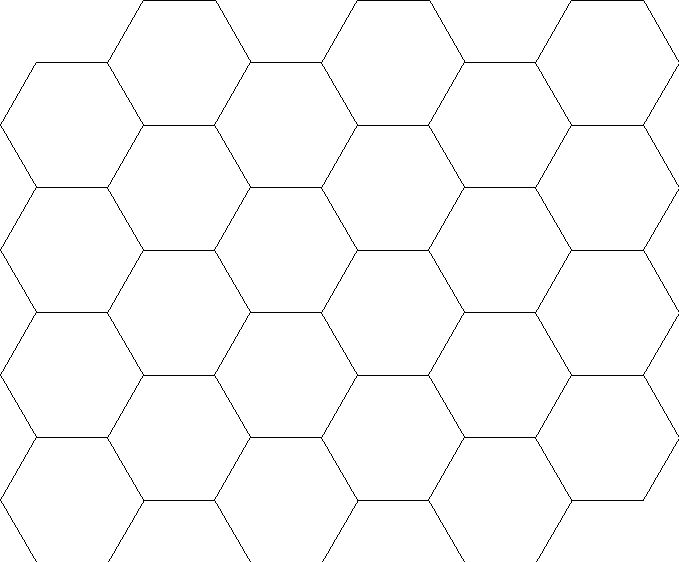
As I compared the two images of the octagonal pattern and hexagonal pattern, I realized it wasn't the vertices that are getting in the way.  It is in fact, the sides.  With the hexagons, you can make a straight line of hexagons, with two opposite sides touching other hexagons, and then you can fit the vertices of other hexagons adjacent to the sides that are meeting the other hexagons to form the line of hexagons.  Wow, that was a super complicated explanation of my thinking, and I don't know if it made any sense to you.  I don't exactly know how to explain it differently. 
Here is my attempt using the Paint program on my computer:
 Red= hexagons in a line
Yellow= two opposite sides of hexagons that are touching other sides of hexagons
Blue= hexagons that are on the sides of those in a line
Green= vertices that fit in to the line perfectly

When looking at the octagonal pattern, they don't have those vertices.  Rather, there are "extra" sides that get in the way, forming dead space in the shape of squares.  I don't really know why that is the case, but that is my observation!
For more explorations of tessellations (say that 3 times fast), you can go to:
http://www.mathsisfun.com/geometry/tessellation.html

I hope you enjoyed following my train of thought!


Thursday, February 20, 2014

A Little Bit About Blaise Pascal

When I read Ms. Mariner's blog, I had no idea what in the world I could write about.  I just didn't know what I thought I could write a decent blog about.  I decided to research a little bit about Blaise Pascal as a person, and this is what I found!

Pascal's birthday is on June 19th, and he was born in 1623. In other words, he is super old.  That means, if he were standing right next to me at this very moment, I would have a really old man standing next to me who had been alive for somewhere around 142,660 days.

When he was a bit younger, only about 6,400 days old (18 years), he created the first arithmetical machine.  If you can create something with that complex of a name by the time you're 18, I'll be proud to say I know you!

Here's a funky twist in the story for you! In 1650, Pascal went down a completely different route, and began studying religion.  Math and religion....hmm... I do not see how they correlate... I mean I guess they say to count your blessings right?!

Okay I realize that this blog is probably very boring and you probably would rather be doing something else right now. I honestly had no inspiration..
I'll continue to think about what I could add, but for now this is all I got.
I apologize if you wasted 5 minutes of your life on this!
Go do something fabulous to make up for it.


Wednesday, January 15, 2014

A Little Bit of Math Humor


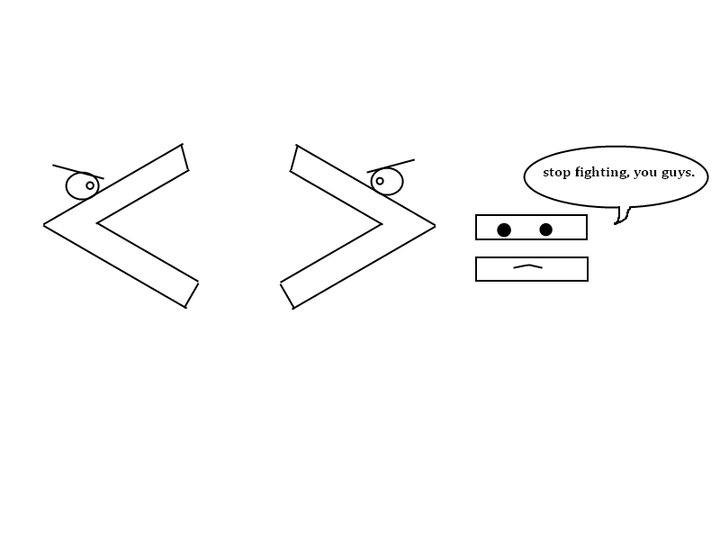
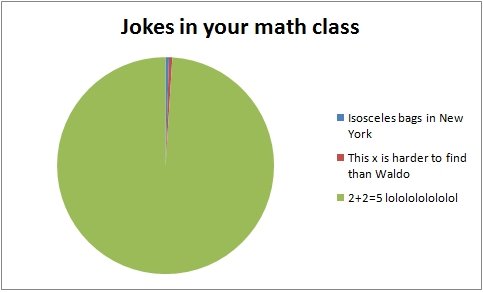
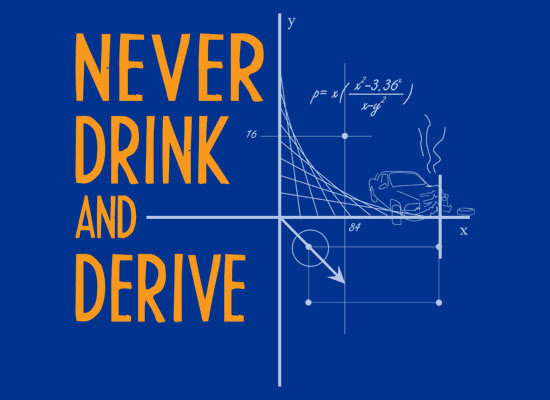
Here are some math joke pictures that I found funny! Some of them relate to current topics, some to geometry, and some are more general.  Enjoy :-) (P.S Sorry if the formatting is crazy!)


http://images4.fanpop.com/image/photos/20700000/Math-Jokes-math-20787060-550-400.jpg


Friday, November 15, 2013

A Cool Story About India's Human Computer Shakuntala Devi


                                                            The video I have attached, that I found on YouTube shows an interview of the astounding Indian mathematician, Shakuntala Devi. When watching the video, there were two main points that stuck out to me.
One of the amazing talents that this woman has is the ability to tell people what day of the week they were born on.  This is shown two times throughout the interview.  Anyone can tell her their date of birth and she can almost immediately calculate what day of the week they were born on.  Although this could be seen as impractical, I think that it is a very neat talent, and I would be interested to tell her my date of birth and see what she says! 

The second thing that intrigued me the most was Shakuntala's goal to inspire others, specifically young adults.  During the interview she talks about her experiences with speaking to high school and college age students who may not have very good mathematical backgrounds.  She expresses the joy it brings to her when the students get so excited and interested in math.  It would be an honorable privilege to get to watch this woman talk about her passion in person.  She inspired me through a five minute video, so I cannot imagine how inspirational she must be in person, for even a half hour talk.

I admire Shakuntala because she has taken her passion, and ran with it.  She is using her abilities and passions to change the world.  Her mind boggling calculations make people think.  She is changing people's perspectives and thought processes. Shakuntala is truly an example of someone making an impact through their strengths. 
Shakuntala is an astoundingly intelligent and admirable woman, who is changing the math world for the better.                                                                                                                                                                                                                                                     

Thursday, October 17, 2013

Mathematicians Are Born, Not Made. (My argument against)

After reading Ms. Mariner's post, and then reading the interview, something got to me.  I looked again at the few things Ms. Mariner listed at the beginning of her blog, as something that we might choose to write on.  I had never thought about this statement before, but now that I have thought about it, I seem to have a strong opinion that goes against the statement.  The statement, as seen in the title is: Mathematicians are born, not made.

I disagree with this statement.  Yes, I believe that people are born with unique gifts and talents.  I believe that it is possible for someone to be gifted in math. However, I also believe that with hard work and determination anyone can master anything.  It may not come easily, but in order to be a true expert at anything, you have to have drive.  Mathematicians are pro math doers.  It takes drive to get to the level of knowledge about math that they have.  In this aspect, mathematicians are similar to athletes.  Cristiano Ronaldo (a very good professional soccer player) was not born a great soccer player.  Yes, one could argue he is gifted, but that gift is not what makes him a professional soccer player.  Lindsey Vonn is an excellent skier for the US Women's Olympic team.  She was not born knowing how to ski race.  She may have been gifted, but again, that doesn't make her a great skier.  Her drive and determination to be excellent, is what makes her that way.  Going back to mathematicians, they have to have the drive, the passion. If they have the gift, but they have no passion, they WILL NOT be successful.

The man who possesses passion with no gift, will be far more successful than the man who possesses gift with no passion.

Monday, September 23, 2013

Secret, or Not so Secret, Math

At first when Mrs. Mariner asked us where we use math in secret, my mind went blank.  To be honest, I really enjoy math, but the whole "apply what you learn" thing, doesn't usually cross my mind when I am going on about life.  I wish I thought that way, but I'm not THAT smart (; After these thoughts finished crossing my mind, I thought about the question again.

Somewhere that I definitely use math or see math being used, is in ski racing.  I ski race on a competitive ski team that competes at United States Ski Association races.  For my age group, there are certain rules that MUST be followed for these races.  One of the things that is important when choosing a ski that will fit the requirements and provide you maximum success, is the turn radius of the ski.

 For example, for slalom, you do not want to have a ski with a too  turn radius.  In slalom, the gates are closer together and you want to make tighter, quicker turns.  Therefore, you have to make sure that the slalom ski you purchase has the right sized turn radius.  Contrary to a small turn radius, for Giant Slalom, you can have a ski with a smaller turn radius.  Giant Slalom is just what it sounds like it is.  The gates are much farther apart than in slalom and you have more time to make larger turns.

Turn radii are very important in ski racing.  This is a way that math applies to my life that I had not recognized until now.  It is kind of cool to see that something I am so passionate about has math involved in many ways, one of those being what I just talked about.

Friday, September 6, 2013

Grades and Slopes

To be honest, when I read Ms. Mariner's 9% grade post, I wasn't sure where to even remotely begin my own post.  Even when she offered for us to write about the triples, I was stumped.  When reading the math illiteracy post, I almost immediately could think of a creative way to respond.  The 9% post however, was the opposite experience.  That's okay though, because it is good to have to think about things!

Before reading the post, I would have never thought that the grade of hills, ramps, or roads could be a "discussion topic."  It is something that I never really put any thought into whatsoever!  However, once you get your mind thinking, it is a very important aspect of building things such as ramps and roads.  If the grade of a road is too high, cars will not be able to safely make it up and down the road.  If the grade of a ramp, particularly for disabilities, is too high, people that are originally trying to have easier access to wherever they are trying to go, cannot make it up the ramp.

In relation to trigonometry, grade is very similar.  Specifically, the angle of elevation is a huge factor.  The angle of elevation is something that, using trigonometry, we can somewhat easily solve for when provided with the proper information.  Angle of elevation is a large factor in grade because it is how much the new slope is "raised up," from the previous ground level. 

In this picture from the wikipedia site that Ms. Mariner directed us to, you can see that a trigonometrical function that comes into play is the tangent (opposite divided by adjacent).  If you know the angle of elevation and one of the legs, you can solve for the other leg. 

http://en.wikipedia.org/wiki/File:Grade_dimension.svg 

In the picture, grade is presented as a right triangle.  Woah! That's what we are studying! Hmm.  Could that maybe, possibly have to do with anything at all?
In the picture, the road is the hypotenuse of the right triangle.  The previous ground level is one leg, and the distance from the previous ground level to the slope is the other leg.  We can use the tangent to find the length of the hypotenuse, thus finding how much the slope increases (or decreases depending on your perspective), in a certain distance.

Grades are an interesting topic that I had never put much thought into before, but I am glad that I had the opportunity to now!